
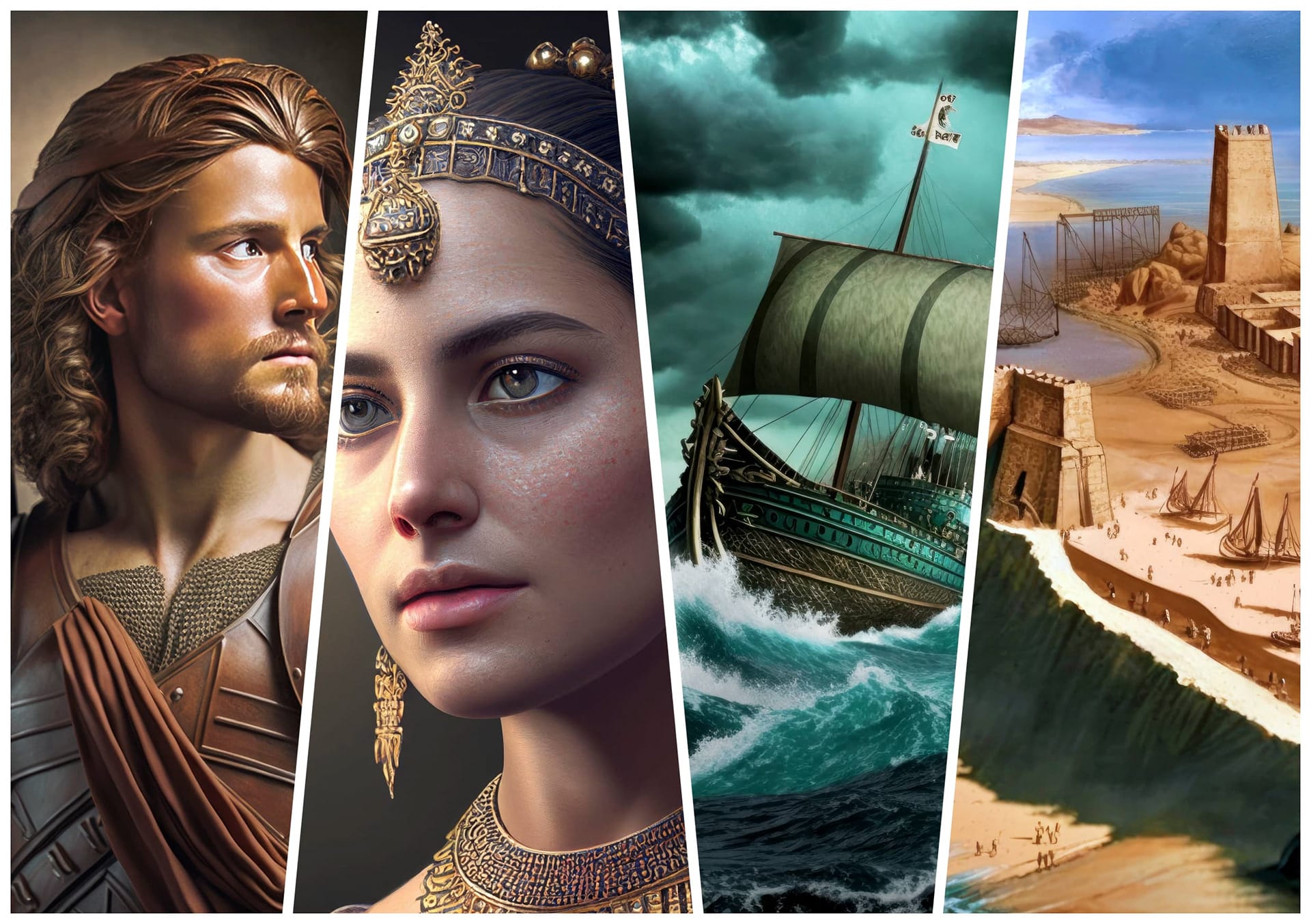
The Aeneid of Virgil — Book I
My translation, with facing Latin text
Please download my translation of Book One of Vergil's epic "The Aeneid". It's a PDF file with facing Latin and English text, brief synopses and endnotes/glossary. About 3.5 MB.
What is Book I of the Aeneid about?
Virgil's poem opens in the midst of the story that it sets out to tell: Aeneas' journey from the fiery fall of the city of Troy to Latium in Italy, where his descendants are destined to found and rule Rome and the Roman empire. Aeneas is a prince of Troy whose father, Anchises, was a cousin of the Trojan king Priam, and whose mother is the goddess Venus (Aphrodite to the Greeks).
Aeneas and his fleet of twenty ships, filled with Trojan warrior-refugees, have been wandering the eastern Mediterranean for seven years. They have been frustrated in their attempt to reach Latium by the enmity of the goddess Juno — the sister and consort of Jove (Zeus) and goddess of marriage. Juno supported the Greek cause in the war with Troy over the abduction of the Greek queen, Helen, from her husband Menelaus. She hates the Trojans and, as it happens, loves the Carthaginians.
Juno enlists a divine "client", Aeolus the god of the winds, to hit Aeneas' fleet with a mighty storm that sinks one ship and scatters the others, blowing them south from their last course which would have taken them, finally, across the strait from Sicily to Italy.
Aeneas, with seven of the ships, limps into a protected harbour in Libya (modern Tunisia) in north Africa, where he and his men have a mournful feast. Next morning, exploring the hinterland, Aeneas comes across his mother, Venus, disguised as a huntress. She directs him to nearby Carthage, after giving him a brief history of the city's foundation by the former Phoenician princess-royal, Dido.
Aeneas travels to Carthage, camouflaged with his mother's help, and admires the work-in-progress on the construction of the city. In the Temple of Juno (patron goddess of Carthage) he finds a series of murals depicting the fall of Troy, including one showing him fighting. He takes this as a sign that his fame has reached north Africa and that he might hope for safety here.
With his mother's help he makes a dramatic appearance before the beautiful young Queen, Dido. He learns that twelve more of his ships have also beached near Carthage, and sends down to the fleet for his son Ascanius and gifts for their hostess, who invites all the Trojans to a banquet.
Venus, meanwhile, worried about Juno's powers in Carthage, devises a trick to ensure Dido will fall deeply in love with her unexpected guest, making her an ally in her son's cause.
Virgil, Rome and the Emperor Augustus
Publius Virgilius Maro was already a much-admired poet when he began to write the Aeneid, probably around 30 BCE; he died in 19 BCE, leaving the poem still in 'final draft' form. He was from Mantua in northern Italy, the son of a landowner of the respectable equestrian class. Despite temporarily losing his inheritance in the civil and military turmoil of Augustus' rise to power, the Emperor personally returned the property to him. He was also supported by the wealthy literary patron and friend of Augustus, Maecenas.
Virgil was one of a group of poets — including Horace — attempting to refine and expand the horizons of Latin-language poetry using Greek (Hellenistic) models. Since before Rome's conquest of Greece more than fifty years earlier, educated Romans had considered their own literature, philosophy and rhetoric "rustic and unrefined" compared to Greek achievements. Many of them were accordingly tutored by Greek slaves when young and completed their education in Greece when they could afford it.
In the year Virgil started work on the Aeneid (30 BCE), Octavian Caesar (later 'Augustus') was the last man standing after a decade and a half of bitter rivalry and bloody civil war among the private armies of Caesar's assassins and would-be successors. Octavian's last and greatest opponent, Mark Antony, and his lover Queen Cleopatra committed suicide in that year, and Augustus now had the power and wealth to craft a new form of government for Rome. In contrast to his blood-soaked rise to power, Octavian/Augustus as Emperor was politically moderate and socially conservative, presiding over a period of prosperity based on peace at home and successful warfare and alliances abroad.
It is possible that Augustus commissioned the Aeneid as Augustan propaganda: certainly he was interested in the poet and the project and was responsible for rescinding Vergil's direction that the draft poem be destroyed after his death in 19 BCE. Instead, so we believe, Augustus directed another well-known poet (Varius Rufus) to tidy up and publish the draft.
In the Aeneid, Virgil (re)created an heroic "national story" for Rome — one that establishes a distinguished, divine genealogy for the Julian clan that included Julius Caesar and, by adoption, Octavian/Augustus, the first Emperor and patron of Virgil.
Virgil's sources
Virgil did not have to invent the role of his hero Aeneas. The Romans of the first century BCE were well aware of their Greek heritage in Latium. Greek colonists from Euboea arrived at Cumae (near Naples, where Aeneas finally touches down in Italy) in about the 8th century BCE, bringing with them the technology of the alphabet — recently acquired from the Phoenicians. By the time Virgil and Livy were writing their great works, the role of Aeneas in the mythic history of Latium and hence Rome was well established.
Virgil's models for epic poetry and national-myth making are the Homeric Iliad and Odyssey, but he was not the first Roman poet to attempt this. The first significant Roman poet still known to us, Quintus Ennius, adopted the same Homeric models — including the dactylic hexameter verse — in his epic "The Annales", published almost 150 years earlier. This was a 15-book history of Rome from the fall of Troy to the age of Cato the Elder (184 BCE), a standard text for Roman schoolchildren in Virgil's time (only some 600 lines survive).
The sources Virgil may have consulted for his characters and narrative has been the subject of centuries of scholarship and speculation. None of which matters much. The characters, scenes, structure and details of the narrative belong to Virgil's imagination. Above all, it is the subtlety of Virgil's poetic expression and the intriguing questions prompted by his narrative — about the nature and value of human will, achievement, duty and love — that merit the poem's place as a foundation work of the Western Canon alongside the works of Homer.
My translation
I can't pretend to convey the poetic impact of Vergil's verse. You'd be much better advised to read the satisfying, slightly "Tennysonian", translation of the American poet Robert FitzGerald (1981), the clear modern pentameter verse of Alan Mandelbaum (1970), or the most recent (2020) successful vernacular translation by Shadi Bartsch, also in pentameters.
The greatest challenge facing a translator of Vergil arises from his poetic skills and the very different structure of the two languages. Latin verse can orchestrate sound and word-structures in a way that is possible only in a fully-inflected language where word order is flexible. This allows a variety of aural and semantic effects — rhetorical devices — that are challenging or impossible to translate into English, where the order of words is more or less fixed by grammar.
Vergil is a master of these rhetorical figures, but his felicities are often lost in translation. The translations I mention above, and even John Dryden (who offers more Dryden than Vergil in his Aeneid translation), manage to echo some of the effects. With less skill, I've focused on getting the sense and tone right.
When I attempted a translation of Book IV of the Aeneid (available as "Dido and Aeneas"), I made little attempt to replicate Virgil's verse forms. This time, I decided to impose a couple of restraints on myself that would echo, to some degree, what we find in the Latin verse.
First, a line-for-line translation. Few, even among the notable translators of Virgil, attempt this: Shadi Bartsch (2020, Random House) is the best of the two examples I know. The biggest risk in attempting to match the concision of Latin is that it can tighten English expression to the point where lines of verse become knots of words. The factor most mitigating that risk is the very wide range of synonyms available in English: there are almost always two or more ways to say the same thing. Besides, if I was going to reproduce Book I in a facing-pages style of translation, line-for-line seemed best.
Second, a metrically similar translation: hexametric verse, as Virgil used in imitation of Homer. Now, six "feet" in English verse must be based on a different metric than Latin uses. English verse-feet are not so much "determined" as "suggested" by syllable stress (vocal emphasis). But Latin verse-feet are dictated by the length of the vowels in each syllable, independent of stress ('ictus'). Hence, Virgil uses six feet comprising dactyls (long-short-short: 'Aeneas') or spondees (long-long: 'Juno') and juggles his expression and vocabulary to ensure his lines are exactly regular, but never dull. The discipline of vowel-length in Latin is, however, much stronger than the slightly-slippery rules of stress in English. I have tried to be exact with my stress-count, but some lines in my translation might be read with 5 or even 7 stresses. Please don't.
I have striven, within these limits, to be accurate in my translation and to use current English expression in the hexameters without falling into overtly 'latinate' sentence constructions. I know of only one high-profile translation of the poem that accepts both of these same constraints: Frederick Ahl's translation for Oxford World Classics (2007). You can find a sample here. I quibble with the details of Ahl's translation and I find the language of his hexameters is often awkward.
But you'll have no problem faulting me, too, on one count or the other if you read the whole thing.